|
|
A
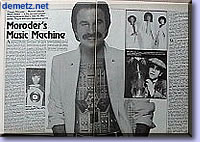
little while ago, a giant billboard on Hollywood's Sunset Boulevard,
boasted a picture of Giorgio Moroder with a computer replacing
his rib-cage.
As well as being an advert for his album-of-the-time (E=MC2),
it was also a salute to an extraordinary and talented producer.
Subliminally it portrayed the utmost substitution of technology
for 'soul' in a trend instigated by him, that affected almost
the entire sphere of popular music.
He was a kind of advance battalion for the main electric invasion
force! However, this journey to a Hollywood hoarding via an Oscar
award, and with more than a little help from a certain Munich
chorus girl, is one of the UK`s lesser known tales.
Italian born Giorgio started life (musically) as a bass player,
gigging around Europe for several years before settling down in
Munich. It was here that he became interested and involved with
studio engineering, at about the time when electronic wizardry
began to figure. "I was very much attracted to modern technology
and the ways in which it could be applied to music," recalls
Giorgio. "When the first 'Moog' came on the market, I knew
I had to have it." This initial attraction blossomed into
marketable product; it was in fact G.M. who was behind several
pop hits of the era, most noticably "Looky Looky" and
"Son Of My Father". Seeds were sown, and sparks akindled
as the age old phrase 'making music' began to take on a literal
meaning for the budding genius. Such was the fascination of the
console, that Giorgio turned to full-time producing and joined
forces with another Munich based aspiring producer/writer - Pete
Bellotte.
|
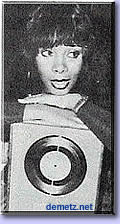 Moroder's Machine "voice" Donna Summer,
with one of many awards
Moroder's Machine "voice" Donna Summer,
with one of many awards |
All
this coincided with another event which was to prove prolific -
the hippie musical 'Hair' ended it's run in the same city. So what?
... so it left Donna Summer, like so many, young, gifted, black
and looking for a job. The partnership was born as she worked for
him as a background singer, soon becoming a featured voice. The
newly formed firm unleashed their ideas on an unsuspecting Europe
and notched up a couple of hits before exporting the notorious "Love
To Love You" to America in 1975. Kinda 'coals to Newcastle',
but it worked - it really worked! it was a monster in the US, and
so popular over here that the BBC banned it! The reasons were to
Moroder obvious: "One of the biggest problems with R&B
in America before disco, was that you had to be a good dancer to
dance to it - it was to complex. So we had to simplify it. We started
by emphasizing the bass line; I think 'Love To Love You' was the
first song with a bass drum played 1-2-3-4 all the way through.
We extended it to sixteen minutes to make the deejays` job easier
and to get people so involved, they would continue to dance to it."
There it is, simple recipe for an all consuming music trend; liberal
amounts of bass line, simmered for an extended time and garnished
with realistic sounding orgasms (use with extreme caution!). The
result 'shot' Donna Summer to stardom and brought G.M. into the
focus of 'Mr Casablanca', Neil Bogart.
Once in the US, his concepts were soon being used by everybody and
their mamma, and although working with Donna and other artists,
Mr M. seemed to become 'just another disco producer-writer'. This
changed when he was offered to write the score for "Midnight
Express", through the connections of Casablanca`s film works.
He considers this to be both an epoch and a highlight in his career
as a performer/composer. We would tend to agree there, film work
is the most suitable path (providing most freedom) for his innovations.
The electronic era contributed further to his case as he scored
the film by watching it on video and putting piano melodies on directly,
which as he explains: "gave me an immediate feeling of whether
something would fit or not."
Throughout
the proceedings Columbia kept a wary eye on things: "they generally
don't use people who never scored (written film music) before, and
I know in my case there are some reservations," states Moroder.
What would happen if every company adopted and adhered to that maxim?
- Catch 22 or what! Their fears were totally groundless, as the
movie went on to blag an Oscar for best score, and Moroder carved
a niche in history, endorsed by the US chart success of 'The Chase'
soundtrack album.
|
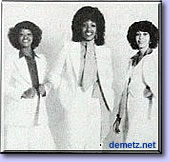 More Moroder charges - The Three Degrees, who achieved
a much needed boost
More Moroder charges - The Three Degrees, who achieved
a much needed boost |
What
was spawned about ten years ago in Munich finally came of age with
"E=MC2" (Energy = Mass X the speed of light squared -
as if you didn't know) the 'ultimate disco album'. Involving twenty-five
computerized synthesizers, four computerized keyboards, three micro
computers and electronic drums, percussion and vocals, it was recorded
thus: "The music was programmed as bursts of energy, coded
numerically into micro computers and recorded via the digital system.
It was then edited by computer and the energy was once again reproduced
as music. It's almost pure sound."
If you didn't understand that, don't worry, neither did the UK record-buying
public. It fared none too well, which is a shame, as G.M. has a
dream of uniting the soul and rock audiences (and lifestyles?) by
merging the music and using each others ideas and techniques to
progress (Funkadelic?). |
That
could be interesting, but back to now and his most recent success
has been the new Three Degrees album "3D" which
has G.M. 'stamped' all over it. Other acts he is currently working
on include Sparks, The Sylvers, Elton John and of course,
Donna Summer. Filmwise he is scoring the much talked about John
Travolta offering, "Gigolo" as well as "Foxes",
starring Jodie Foster and Adam Faith. The latter should
get a good audience, being about wayward teenage girls, as opposed
to little red animals! He feels under no obligation to follow up
with another Oscar, taking the view:"If it works - beautiful,
if not, we just record another one." But he should provide
an entertaining and 'picture enhancing package', whatever.
As we hinted before, maybe he should concentrate on film music,
as the electronics of "E=MC2" come across as being a bit
eerie and feelingless - hardly party stuff! He has shaken-up popular
music in a way that will never be forgotten, but seems to have gone
up a blind alley recently, and a bit of a re-think should perhaps
be on the agenda. But that may be said against him, and a man of
his talents could easily put that right.
Definitely on for the Hall of Fame, and next time you think how
simple a tune is to dance to, remember Giorgio Moroder - the silicone
chip's answer to Arthur Murray!
(LB)
|
|