|
|
Summer
love
One of a family of seven, Donna Summer was born in 1948 in Boston,
Massachusetts, where, in the classic tradition of black American
singers, she first sang publicly as a church-choir soloist at
the age of 10. After moving to New York as a young adult, she
optained her first worthwhile professional break when she was
cast in the musical Hair, which entailed her moving to Munich,
West Germany. From 1967 to 1974 she remained in Europe, working
as a singer in a variety of shows including Godspell, Porgy And
Bess and Show Boat; elements of this background in conventional
showbiz were to be apparent in many of her later activities.
- In 1974, now with a young child to support, Summer answered
an advertisement for a female backing singer. She got the job,
thereby making contact with Moroder. They made an album together,
a slight affair called Lady Of The Night, from which single, 'The
Hostage', sold well in France and Holland, although not in the
major US and UK markets.
- The following year, under the dual influence of Jane Birkin
and Serge Gainsbour's soft-porn best-seller `Je T'Aimec
Moi Non Plus' and the orchestral soul epics of Barry White, Norman
Whitfield and Isaac Hayes, 'Love To Love You Baby' was released
after an earlier single version had failed. Re-written as a 17-minute
erotic epic, it took up a whole side of an LP of the same name.
A single version reached Number 4 in the UK and Number 1 in the
US, achieving similar acceptance all over Europe. The record's
sumptuous catalogue of orgasmic groans and gasps set against a
sultry backing captured a lucrative, adult market.
- The next album, 1976's A Love Trilogy, confirmed the Summer/Moroder/Bellotte
musical identity in the public mind. The arrangers created a polished
mesh of dense rhythmic pulses and spry string embellishments to
accompany her breathy explorations of love and sex - before, during
and after. Once more, a whole side was devoted to a single extended
track - this time, 'Try Me'. This successful formula was repeated
on the album Four Seasons Of Love, released in Britain the same
year. Consisting of four lenghthy tracks, it yielded a minor Christmas
hit with 'Winter Melody'.
|
|
| -
Moroder, Bellotte and their Oasis company had paved the way for
a plethora of European disco imitators. Donna Summer was generally
regarded by critics as little more than the shop-window for a shrewd
commercial operation. An idealized Broadway vision of female glamour
she certainly was; but she often captured the melancholia, confusions
and transience of contemporary courtship, striking a sympathetic
chord not only with female teenagers and disco dancers, but also
with an increasingly visible generation of gay men. Donna's delight
was being gradually eclipsed. She was, by now, the undisputed Disco
Queen; glossy, 'girly', but sufficiently of the real world to be
a genuine heroine.
Deep
thrills
In 1977, as the disco market flooded with sterile, crass imitators,
Summer decided on a change of approach. The I Remember Yesterday
album was largely a collection of pastiches, and two of the hits
it contained - the Forties-style title track and the Sixties-style
'Love`s Unkind' (a UK Number 3 in December) - offered nothing
more than nostalgia. She also recorded the theme tune of the film
The Deep (1977), a halfhearted attempt to cash in on Steven Spielberg's
Jaws (1975). All this suggested that she was becoming a new, bland
family entertainer. However, I Remember Yesterday contained one
real surprise in 'I Feel Love', a single that unleashed Moroder's
'Europercussion' sound - a backing track composed entirely of
programmed synthesizers. The record made Number 1 in the UK in
July 1977, marked Summer's final farewell to bedroom reveries
and heralded the true arrival of the synthesizer in mainstream
pop.
- The same year saw further Donna Summer product, a grand conceptual
project in double-album form - Once Upon A Time - which narrated
a modern-day, fairy-tale quest for true love. The album contained
some of Moroder's finest arrangements, notably the synthesized
'Act II', and also revealed Summer's capacity to express a song's
sentiments. If she lacked the power of a Diana Ross, she boasted
a vocal ache that was all her own - showcased by the hit single
'I Love You'.
|
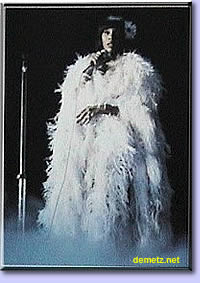 Above: Donna
Summer - a disco dream of the Seventies in fur and feathers.
Above: Donna
Summer - a disco dream of the Seventies in fur and feathers. |
With
characteristic business acumen, Oasis catered to the affluent American
public's by-then established taste for live double albums by releasing
the shabby Live And More in 1978. It chart-topping status in the
US proved conclusively that Donna Summer was now a consumer favourite
for her albums as well as single releases.
- This state of affairs can be good news for an artist financially,
but often signals an artist decline. Sadly, Donna Summer's subsequent
output mostly served to confirm this rule. The great exception,
however, was Bad Girls (1979), perhaps her finest recording. It
was another thematic work, and another two-record set. Broadly based
around the aspirations, experiences and (rather less plausibly)
the appetites of street-corner hookers, two of its sides merged
disco, rock and (for the first time in the traditional sense) soul
to unstoppable effect. The assertive confidence of the opening 'Hot
Stuff' track (an American chart-topping 45) was maintained throughout
the LP, making Bad Girls undeniably her album.
|
|
- The high standard of Bad Girls was not maintained, although
single releases such as an overblown rendition of 'MacArthur Park'
and 'No More Tears (Enough Is Enough)', a shrill duet with Barbra
Streisand, were predictably popular. The Wanderer (1980), released
on the Geffen label and her last with her initial collaborators,
Donna Summer (1982), produced by Quincy Jones, and She Works Hard
For The Money (1983) were all patchy efforts, with occasional
gems swamped by much that was cliched and trite; all were blighted
by routine MOR rock instrumentation.
- This creative decline coincided with Summer's marriage to songwriter
Bruce Sudano and their subsequent conversion to the 'born again'
school of Christian fundamentalism. Although it might be unfair
to link religion to Donna's musical output, the inward-looking
conservatism and sentimentality of most of her Eighties releases
are elements that lie at the heart of the back-to-the-Bible movement.
- Summer's empathy for working woman of all kinds - given vivid
expression on the title track of She Works Hard For The Money
- has perhaps been her greatest attribute as a recording artist.
Whatever themes and styles she pursues in her future recordings,
her various greatest hits collection are worth anyone's hardearned
pay.
Dave
Hill
|
|