|
|
Disco
was born in Europe, in the France of the early Sixties when an
enterprising Parisian restaurateur decided to provide recorded
music for his customers. Hi then added a light show: whoila`,
la discoteque! The idea spread to England, and then the US. At
the end of the Sixties, boosted by the salsa-influenced American
dance, the Hustle. Barry White's 1974 US Number 1 'Can't Get Enough
Of Your Love, Baby' and Gloria Gaynor's 'Never Can Say Goodbye'
of the same year helped re-establish disco, this time whit a much
more distinct soul based sound.
Before Gloria Gaynor became the first Queen of Disco in her native
America acts had dominated throughout the Sixties. At the turn
of the decade, a small number of mainly Dutch groups enjoyed international
success. EMI/imperial producer Klaas Leyen was responsible for
the Cats, while George Bouens wrote, produced and performed with
the George Baker selection. Their second million-seller, 'Paloma
Blanca', owed much of its European success to the tremendous exposure
it received in the discos of European holiday resorts during 1975.
|
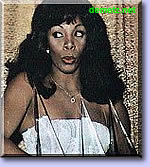 Donna Summer
casts a glance at mentor
Donna Summer
casts a glance at mentor
|
Robert
Van Leeuwen wrote, produced and played lead guitar for Shocking
Blue. Their 'Venus' topped the American charts and sold 10 million
copies worldwide in 1970. This sort of success showed that European
material could sell globally, and encouraged others, like Italian
writer and producer Giorgio Moroder, to try and produce English-language
material for the world market.
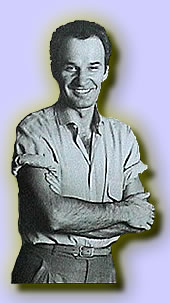
Moroder, the most successful of the continental producers, was born
in St. Ulrich, South Tirol, where he studied at the local Academy
of Fine Arts. He later traveled Europe as bass player in a band
playing hotels and small clubs. In the early Seventies he wrote,
produced and performed on a number of hit records in Germany, a
country where soul was popular due to the US military presence and
American forces network radio.
Moroder based his recording activities in Munich. Only a three-hour
drive from his home in Northern Italy, it was the nearest city with
modern recording facilities. In 1970 he met Englishman Pete Bellotte,
who later enjoyed some success as part of the studio band Trak.
They formed Say Yes Productions and licensed their product to Oasis
Records, which was based in the same hotel complex as the Musicland
studio they used. Bellotte and Moroder enjoyed some success as songwriters,
most notably with 'Son Of My Father' in 1972. In England, Chicory
Tip took a cover version to Number 1, while Moroder's original was
a minor hit in the States. Even then, the hook-line was played on
a synthesizer, the instrument that was later to dominate Moroder's
sound.
Erotic
epic
It was the duo's historc partnership with Donna Summer, begun
1974, that was to make such a lasting impact on the disco world.
After producing some locally-released records, the Bellotte/Moroder/Summer
partnership struck gold with the 17-minute epic 'Love To Love
You Baby', an erotic litany set to a mesmeric disco beat. An edited
single version swept to international chart success at the start
of 1976, and laid the foundation for a career that eclipsed all
other disco stars. In the US Donna Summer enjoyed four Number
1 singles and three Numer 1 albums between 1978 and 1979.
Explaining their success in Music Week in April 1977, Moroder
suggested that 'our style was a lot different from the black American
style. We make it really commercial, and we found a way to make
the bass sound more interesting, and to add little melody hooks
to make it stand out from the run-of-the-mill heavy funk that
was around at that time ... We aim at a more laid-back disco sound,
which not only makes the record danceable, but makes the dancer
go out and buy it... I think that we invented the bass drum and
bass sound that is a feature of the modern disco style, and we
never break the dancing rhythm. In this way I think we have innovated
the whole disco scene.'
In an interview with New Musical Express 18 months later, Moroder
defined their style. 'we take something from everything, than
make it our own, although it is hard to analyse this exactly.
There are obvious aspects we used from the Philadelphia sound.'
Motown was clearly another major influence.
|
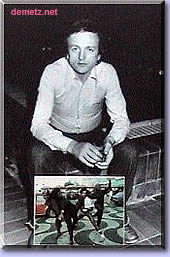 When Frank
Farian created a hit record in the studio, he created Boney M
(inset) to promote it.
When Frank
Farian created a hit record in the studio, he created Boney M
(inset) to promote it. |
In
the earlier Music Week interview, Pete Bellotte had outlined the
way he and Moroder worked. "The process starts with a reference
track of rhythm machine. Without it we could never keep things tight
for a 17-minute disco cut. Using that as a guide, we bring in the
bass and drums to the rhythm section track, and then the arranger
is called in to add things on top of that. However, most of the
arranging is done in the mixing stage as a kind of post arrangement
process. Very little is preconceived... the only thing that is really
though out in advance is the bassline'.
Moroder produced other acts such as Roberta Kelly and recorded four
solo albums of his own. He also enjoyed great success with films,
winning an Oscar for his electronic score of Midnight Express (1978).
AS musical director of American Gigolo (1980), he produced Blondie's
transatlantic Number 1 of the same year, 'Call Me'. His contribution
to Foxes (1980) included Donna Summer's `On The Radio', while his
soundtrack to Cat People (1982) drew widespread critical acclaim.
|
|
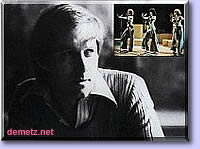
|
Michael
Kunze was the production brain behind the mid-Seventies hits of
Silver Convention (inset) |
While
Moroder and Bellotte were creating Donna Summer's sound, Michael
Kunze was independently making similar excursions with Silver Convention.
Kunze, a successful German lyricist, started producing in the early
Seventies, and scored a moderate hit in 1975 with Silver Convention's
`Save Me', initially on the Jupiter label. The repetitive, thumbing
follow-up, 'Fly Robin Fly', went to Number 1 in the States at the
end of the year and sold a million, as did their biggest British
hit, 'Get Up And Boogie', released in 1976.
There was other producers and artists at work who helped to create
a 'European sound', notably French disco star Sheila and B. Devolution,
while some of Abba's records, such as 'Dancing Queen' and 'Knowing
Me Knowing You', helped to define the new European pop sensibility.
One of the most successful acts in this field was Boney M, the brainchild
of German producer Frank Farian.
As a solo singer, Farian had topped the German charts in 1976 with
the millionselling ballad 'Rocky'. He then produced a disco record,
'Baby, Do Ya Wanna Bump?', a studio creation made entirely by session
men, which he credited to Boney M as simply a name to put on the
record label. When it became a hit there were embarrassing requests
for the act to appear on television, prompting Farian to create
a group called Boney M to perform his music.
'Daddy Cool' was the firs Boney M single that the group sang on
themselves. A string of Eurodisco hists followed, although their
impact in the US was limited. In 1978 they hat two British Number
1 singles, including the massively successful 'Rivers Of Babylon'/'Brown
Girl In The Ring', and a Number 1 album, Night Flight To Venus,
which sold millions for the European-based Hansa Records. Two further
UK chart-topping albums followed before in the bubble burst.
Farian worked to a certain formula, first recording his backing
tracks, usually in Munich, and then trying the tapes out at a disco,
using public reaction to gauge the best cut before recording the
vocals on top. In common with other Eurodisco producers, the syndrum,
with is considerable range and pitch, was central to his sound,
as was the extensive use of synthesizers.
The so-called 'Munich Sound' became widely celebrated, with major
bands such as the Rolling Stones and ELO using the Musicland studios,
although - as Pete Bellotte pointed out - there was nothing particularly
German about it. Rather, it was a meeting-point for talent drawn
from all parts of Europe. Say Yes Productions, run by Bellotte (English)
and Moroder (Italian), employed an Icelandic arranger and a teem
of session players (who recorded a couple of albums as the Munich
Machine) drawn largely from Britain and other parts of Europe.
Germany
calling
Although Moroder has commented that they might all have been successful
earlier if they had been based in London or Los Angeles, the fact
is that they were based in Munich which was where, in the mid
Seventies, everything came together at the right time. It was
German record companies - Oasis, Jupiter and Hansa - who put faith,
time and money behind Eurodisco. With that support, and as a result
of the work of producers like Giorgio Moroder, Pete Bellotte,
Michael Kunze and Frank Farian, Eurodisco became a significant
strand of international popular music in the late Seventies.
Demitri
Argyropulo
|
|