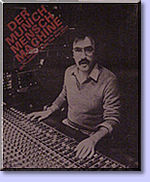
|
"LOOK,
I tell you something very important. Too many of these writers in the
music papers, they are misunderstanding everything. "The disco sound,
you must see, is not art or anything so serious. Disco is music for dancing,
and I know that the people will always want to dance.
" Also, disco is becoming more and still more popular over the last
year. The big American record companies are giving much money to it. This
is very good. This makes me very happy, especially when I know that disco
is soon to be the soul and R&B sound of today.
"And these ideas the writers are having about us using machines and becoming
like machines - they must be making a joke. I know for sure that we are
and maybe, as I think you say in English, we are having the last, longest
laugh."
Seasonally set and matched in brown woollens and tweeds, Giorgio Moroder
grins like a Halloween mask, folds hands across chest and self into high-backed
wicker chair, then tilts head, trim moustache and shoulders askance, as
if to better observe the effect of his words.
In fact, Moroder seems as much bemused as amused. As well he might. The
producer of Donna Summer, Roberta Kelly, The Munich Machine and, most
recently, Sparks, Moroder has unwittingly - or so it seems - precipitated
a veritable flash-flood of madcap-modernisms and pseudo-sociological static.
Impossibly grandiose and improbably specious claims have been made on
his behalf. He has, we're told, almost single-handedly dehumanised disco,
formulated a sono-track for much more than just another auto-style age
even introduced an entirely novel 'post-Euro-industrial' sensibility into
modern dancing methods.
Moroder is, the radical chic surfers of the disco wave inform us, as crucial
to the developing of the new 'disko' aesthetic as are, say, Kraftwerk,
Bowie, Eno, Amanda Lear, The Baader Meinhof and Devo.
Are you still with me? Never mind, I`m not even with much of this myself.
But remember "I Feel Love" and recall Ms Summer's vocal sex-flexing
and Moroder's accompanying electronic pulsebeat-heat. The song was, of
course, suggesting that modern sex was machine sex, wasn't it?
Well, no. At least, not as far as Moroder is aware. In retrospect, he
finds the song "sexy and funny at the same time", and is justifiably proud
of it. He describes it as being intentionally "futuristic", but nothing
more. (Exeunt robo-clones and auto-lovers world-stage right).
So there. And as for the Made In Germany By Germans strait-suit that has
been repeatedly pressed onto Moroder's output. It doesn't fit: Moroder
is Italian. So there again.
Meanwhile, lest we forfeit focus, I sit in the hyper-plush - even the
carpets seem to purr - shared offices of Oasis Records and Musicland Studios
in a hotel complex on the outskirts of Munich, Bavaria, West Germany.
I observe the plastic palm treelet (Oasis' trade logo) by the desk and
ponder the patent discrepancy between the fact and fiction that is and
isn't Giorgio Moroder.
This
affable and amiable man is not, I surmise, a conceptual metaphysician.
He is a producer and, above all, a businessman. I glance at the reading
matter stacked conspicuously by his doodlepad and note two titles: Elaine
Jensen's Number One With A Bullet, a factional novel about the
more dubious operating methods of An American Record Company (Tamla Motown
snapped up the book's film rights but have not so far displayed any inclination
to film it), and Clive Davis' 'Inside', the recollection of the current
Head of Arista Records whom, you may recall, was given a rather premature
golden handshake in the wake of numerous payola and drugola allegations.
Both
books are regarded as essential instruction for the aspiring music industry
magnate. Not that Moroder himself has overmuch to aspire to anymore. In
the week of our interview Donna Summer's 'Live And More' album and 'MacArthur
Park' single had topped their respective US charts.
There really does seem to have been a slight msunderstanding here.
GIORGIO
MORODER was born in the Dolomite hills of Northern Italy some
36 years ago. He started playing guitar when he was 16 or 17, then left
both school and home at 19 to play in what he deems "a more or less dancing
group". Subsequently, he toured Europe for more than five years, even
- and here Moroder warms to memory like a cat before an open hearth -
"playing at a gala in London's Savoy Hotel".
In
1967 Moroder curtailed touring to concentrate on writing or "composing"
as he has it in his very acceptable English (he also speaks French and
German). He had already had some experience of recording and had been
making "little" demo tapes of his own.
"I
was quite lucky," he relates. "I had my first hit as a composer about
six months after I started writing all the time, with a German song in
'68.
"Then all the good songs were coming from England and America and so for
some time I didn't try to compete by writing in English. My music was
typically Continental - nothing like, say, The Beatles."
Continental as in Eurovision pop (awopaboomabangabomp)?
"Kind of. I was happy to have a hit, but my intention was always to compose
with an English or American feeling. Then in '69 came the bubblegum wave
and I made a recording in Berlin, my first as both composer and producer,
a song called 'Lookie, Lookie'. It did well in France, Italy and Spain,
even bubbled under in America.
"And again in '70 I met Pete Bellotte and we began to write together.
One of our first collaborations was a smash hit in England for Chicory
Tip, 'Son Of My Father'. This was my first major hit, and since then Pete
and I have worked almost always in English."
Bellotte had been working in Germany with a rock band going out under
the unlikely name of, I think, Linda Laine And The Sinners.
English and hailing from a village in the Home Counties, he eventually
expatriated himself, settling and marrying in Munich towards the end of
the '60s. He met Moroder through Ariola Records, for whom the latter was
undertaking occasional production work.
On the evidence of one brief encounter at Musicland, Bellotte, who resembles
nothing so much as a Moody Blue after an extensive overhaul at a health
farm - he's extremely thin - seems a tenaciously reticent individual.
He refused to be either photographed by Jill Furmanovsky or to be interviewed
by your hack.
The exact nature of his partnership with Moroder is difficult to fathom.
He shares almost all writing and producing credits and also records for
Oasis in his own right as half of Trax. His nervy, introvert manner contrasts
completely with that of the self-assured, extrovert Moroder - which is
probably why they work so well together: opposites in action and reaction.
Moroder himself is quick to disclaim all but a passing interest in rock
music. The upheavals therein of the late '60s, he says "meant little to
me; I guess I have much more of a commercial feeling and so was not greatly
affected by them.
"But our big start, of course," he continues, "was Donna".
Donna Summer first encountered Moroder, variously described as anything
from (her) benign benefactor to megalomaniac manipulator, in late '73.
She had answered requirements for one of three back-up, preferably black
female, vocalists; at the time she was living in Munich in an advanced
state of penury with a child to care for. Moroder was "quite impressed
by her voice, although I didn't think about doing anything particular
with her".
Six months later Moroder and Bellotte persuaded Ms. Summer to sing a song
of theirs entitled "The Hostage". It hit the hi-spot in France
and Holland, as did its rapid follow up (both songs can be located on
the 1974 "Lady Of The Night" album). Moroder and Bellotte were,
however, frustrated with their failure to "penetrate" the much more lucrative
UK and US markets.
"So," Moroder chuckles, "one day I thought we should do something a little
more sexy. Just for fun. There had been this big hit with Jane Birkin's
'Je T'Aime" years before and I wanted to do something like that again.
We left it for a while until Donna came back to me with an idea for the
lyrics. We did it just to see if it worked, and it did."
But not immediately; even the best laid plans of mice and Moroders are
fallible. Moroder's "Something a little more sexy" transpired to be "Love
To Love You Baby", conceivably the first worldwide disco mega-smash.
Moroder and crew had prepared a demo "with a very catchy bass-line, a
very emphatic bass drum part and a funky guitar, sort of Philadelphia
feel. We knew exactly what we wanted."
They duly superimposed Ms Summer's sweet-nothing sex-selling and released
the creamy confection as a four-minute single.
Nothing (much) happened. In some desperation Moroder decided to hook a
bigger bream and stretch the song over a full 17-minute album side.
Again, his sure commercial sense had prompted him to recall another blueplan
which he was determined to adapt and improve, in this instance Iron Butterfly's
stupendously frightful "In-A-Gada-Da-Vida" rock supa-solo-spree
(he only heard it, he claims, because it charted and so won radio play).
And now the gamble and the gambit mated. The stretch transformed a slight
sono-sex serenade into an indefinitely suspended and indelibly supine
sigh of musical mood engineering. And, most importantly, the radio programmes
and discotheque DJs could simply lie back and lay off to it all, letting
the maxi-song muster up its own magery.
Which it did. The "Love To Love You Baby" album turned up trumps
in the States, as did the re-activated single (whilst Moroder was later
to record a version of "Je T'Aime" with Summer for the "Thank
God It's Friday" soundtrack).
Moroder was made. Suddenly most of the Western world was making some sort
of love to Donna Summer tonight. And every other night.
"Then", the man admits, "it was disco all the way".
AS
FOR "I Feel Love", its genesis was similarly accidental. Donna
Summer's "I Remember Yesterday" was intended as a collage of
various musical stages and styles. Inveterate and by now incisive copyists,
Moroder and Bellotte had successfully subsumed '30s Dixieland, Phil Spector,
early Tamla Motown, Philadelphia, proto-disco and now-disco into the set,
whereupon Moroder postulated a next-disco sound.
"I had already had experience with the original Moog synthesisers, so
I contacted this guy who owned one of the large early models. It was all
quite natural and normal for me. I simply instructed him about what programmings
I needed. I didn't even think to notice that for the large audience this
was perhaps a very new sound. We did the whole thing in a day."
Moroder goes on to divulge that he recorded an all-electronic album of
his own some years ago, working on the project for several months before
failing to find an outlet for it.
In this connection, I inquire of him his opinion of Kraftwerk, whom some
assert have been a de facto influence on Moroder's electronic work
- whereas the reverse is probably more the mark, since Kraftwerk's first
direct-disco release, "The Man Machine", postdates Moroder's
own electronico-disco "From Here To Eternity" by nearly a year.
Although the horizons here are hazed. Kraftwerk certainly required something
of an extra edge to compound the disco-cult success of "Showroom
Dummies" from "Trans-Europe Express" - a success which,
incidentally, seems to have caught them unawares - and they may well have
found what they needed in Moroder's methods.
"'The Man Machine" may carry the emphatic 'Produced In West
Germany' rider but the album was actually mixed by, among others, Leonard
Jackson, the latter on loan from ex-Motown writer and producer Norman
Whitfield's Whitfield Records. Whatever, Kraftwerk's "Spacelab"
(from 'TMM') runs Moroder's sound so close a second it's hard to resist
implying plagiarism on the part of the Dusseldorf Dynamen.
But does any of this matter anyway? Yes, merely because Kraftwerk have
contentiously obfuscated their work with notions of 'artistic', 'political',
'historical' and 'sociological' intent and intrigue - and they have been
rapturously repaid by writers who really should know better by now for
doing so.
By comparison Moroder's declared first base - making pure electronic pop
- seems also charmingly, defensively banal. And yet not only has it had
a far greater impact (Kraftwerk's lack of major chart success since 'Autobahn'
has been signal), but it has also been haplessly absorbed into the critical
caucus of (SIC) New Europeanism.
All of which begs questions. Are we really the robo-men-machines of Kraftwerk's
"The Robots" (and, if so, then why aren't we purchasing their
product?) or do we just want to dance? And how do you disco? With body,
brain, or both? And whatever would Fritz Lang, film director (Metropolis
and latterday hero of the Euro-men), have said? (Pfft!" probably).
"Kraftwerk," Moroder muses, "I like their sounds very much because
they are very clean, but I don't particularly like the songs. They are
sometimes a little too easy in their music..."
Easy as in facile?
"Maybe. Honestly, I prefer Tangerine Dream, that kind of thing. I used
to know these guys very well, and loved their 'Phaedra' album very much.
There were some similar groups in Munich - Popul Vuh, for example - some
years ago.
"Personally I feel that Tangerine Dream became a little boring. You can
only do so much and no more with all these sequencers. But Kraftwerk?
Well, I think they thought that they must start selling more. I guess
they are making a simple mistake. They still reckon that with an easy
melody and a synthesiser they can have a hit.
"Whilst in fact the audience is becoming more and more sophisticated.
We ourselves started with simple songs, but something like 'MacArthur
Park' is different, very complicated to make. We are always trying very
hard to improve the overall quality of our work, while Kraftwerk are still
holding on to the older ways of recording. If I were to record another
synthesiser album right now, I wouldn't do it at all like 'I Feel Love'.
That sound is out of date and use."
But, double-track, there is a marked similarity between the disco-dub
effects Moroder employed on his mostly instrumental soundtrack for Alan
Parker's Midnight Express and those Kraftwerk deployed on the "Metal
On Metal" segment of the title track of their own "Trans-Europe
Express". 8
|