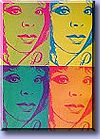
|
7
... after being worked to death--nearly dying," says Summer.
To save gerself, she returned to God. "I believed in God my
whole career, my whole life, since I was a little girl," she
says. "God in that sense wasn`t new." What was new was
her commitent. "I had no alternative. God was the only door.
Otherwise it was death." She feels the reasons behind the breakdown
are "personal and nobody`s business," saying only, "There
were certain events in my life that were painful to me." In
her relationship with God, she found new purpose. "To love
and not to hate. To be what I`m supposed to be. Everybody, in some
way, needs that center. However they perceive it, whatever it is
to them. They need to have that balance, because when you look around
and see what`s going on, it`s terrifying out there!" she seems
to exude a set of values--love, compassion, charity--that are more
closely associated with Christ than with today`s fundamentalist
Christians.
Much
was made of donna Summer becoming a "born-again Christian."
At that time, the popular perception of what it meant to be a born-again
was changing dramatically.
For
much of the late `70s and into the `80s, our do-gooding president
Jimmy Carter represented, for most Americans, the quintessential
born-again Christian. After the election of Ronald Reagan, the religious
right attempted, somewhat successfully, to convert Christian fundamentalism
from a grassroots religious movement into a potent political force.
as a result of that, says Summer, "I think there are a lot
of misconceptions about Christians."
Donna
herself may have been a victim of one such misconception. When asked
about statements she reportedly made that could be construed as
homophobic, Donna sights wearily with resignation, almost exasperation.
These are old allegations she feels she has spoken to many times
before, she says. "I don`t know what to say about that at this
point. it was over 12 years ago. at this point it`s not even news."
She believes that by further discussing the nonevent, she extends
its life. But understanding the sensitivity of the issue, she good-naturedly
and unequivocally denies the story. "I never said anything
like that in the first place--nopthing like that ever came out my
mouth." she further recalls, It was really devastating to me
as a human being to feel that people were saying things about me
that were so far from the truth. it was painful sometimes."
Reflectively, Summer points out, "I have lived with rumors
my whole career. People
said i was a transvestite--hello!" In 1977, when a rumor surfaced
in the press, she said, "You can`t trace a rumor and you can`t
kill a lie."
|
"I
believed in God my whole career, my whole life, since I was
a little girl... God in that sense wasn`t new. I had no alternative.
God was the only door. otherwise it was death."
|
Today, as a mother of three, Summer is less concerned with what
others say about her. she believes people can best be judged by
their actions. Donna utilizes her time and her talent doing good
works, among them, a benefit for Gay Men`s Health Crisis in 1998
that raised $400,000. More recently, she performed at a concert
for Nebraska AIDS Project. An accomplished painter who bemoans the
lack of time she has to devote to her visual arts, Summer melds
the modernist styles of Modigliani and Picasso.
Using
vibrant colours and bold brushstrokes, her ethernal figures offer
a compelling look into her heart. Her work is currently touring
Japan as part of an "Artist for Art" charity exhibit.
Whatever
happened to the stratospheric career of Donna Summer remains a music
industry mystery. "People like variety," she says. "It`s
just a human nature and taste; you don`t sit around eating ice cream
every night." By the early 1980s, disco had also become almost
a caricature of itself ( remember "Disco Duck"? ). New
wave became hip, and because of the movie Urban Cowboy, country
became cool. Donna`s departure from her signature sound may have
also disappointed her fans. In 1982, Laura Branigan singing "Gloria"
sounded more like Donna Summer than Donna Summer did. And as formidable
as Geffen Records was to become, being with a new label without
an established promotions department may have contributed to Summer`s
waning popularity. Whatever the reasons, the disco craze ebbed and
the queen of disco faded with it.
In
talking now about her life and her career, Summer speaks with a
wisdom gleaned not from the descent to an orbit of a lesser star.
"Money isn`t more important to me than people," she says.
She recounts a story about her granddaughter Vienna hearing on of
her new song. "One one of the high notes, she lifted up her
arms and opened her mouth like she was singing. Only 2 years old
and she already has the drama down." Laughing proudly, Donna
describes Vienna as "a diva in training." Summer now lives
in Nashville with her husband of almost 20 years, Bruce Sudano.
Without prompting, she firmly states, "My career is what I
do for a living. my family and my friends and the...
8
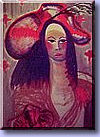
"Dreamer" 1999
|
Using
vibrant colours and bold brushstrokes, Summer melds the modernist
styles of Modigliani and Picasso. |
|