|
GIORGIO
MORODER is a self-made man, and not ashamed of it. He readily admits he's
been "very lucky", but knows his worth. "En Route Moroder' (On the Moroder
Road), his associates at Oasis say, describing the constant debilitating
commuting Moroder's schedules force him to undertake between Munich, London,
New York, Los Angeles and, not as often as he would like, his home in
Switzerland ("I live there not for tax reasons, but because I like it
there").
Moroder sees himself primarily as an entertainer and rejects interpretations
of his work as Art, preferring to believe that he is merely producing
music that caters for a genuine popular demand.
"Generally I don't think there is too much art involved in what I do.
I would not, however, be happy to do what I do unless I felt that the
large audience wanted it. But I do know that I achieved something specially
different with "Love To Love You Baby" and "I Feel Love".
These songs will, I think, endure. They might even be hits again in ten
years time.
"I can't explain my own success very well. It surprises even me sometimes.
I seem somehow to have this ability to make everything right and put it
in order - lyrics, melody, singer, arranger, all these factors.
"Yes, sometimes we aim things at a certain audience. We did make Roberta's
second album around an astrological theme because she wanted to and because
we know the Americans are crazy about Astrology.
"Donna's appeal? She is, of course, a beautiful woman, but I guess it
is the whole production, the package that matters more. In fact most of
this presentation aspect is due to Casablanca, not so much to Pete and
me.
Together though, them and us, we seem to have found a way to give an artist
a worldwide appeal, to cover all the markets..."
Amanda Lear (Roxy Music "For Your Pleasure" cover starlet and
black leather'n'whip specialist responsible for a remarkably redundant
disco escapade in this years "Sweet Revenge") has been quoted
as saying - in Rock et Folk, August '78 - that although Donna is "very
gifted', she is "completely manipulated. They make her sing ineptitudes".
"If that is her opinion, so may it be. Actually, Donna and Pete and I
collaborate closely on many of our projects. Donna would not, I know,
agree to something unless she wanted to do it in here heart.
"And now you talk of how they say that I, a white producer, should not
make songs with a black girl. This is ridiculous," Moroder smiles, "nobody
even knew I was white when 'I Feel Love' first came out. When I went to
see Donna in performance in New York, the audience was all black, but
nobody minded, there were no remarks about this to me. Personally, I am
certainly not racist; I even like the British..."
Chuckles and more coffee all round.
"Although, I must say this," Moroder proceeds apace, "that disco does
work good or better with black artists or players. They just feel it more.
It is as I say about disco becoming the soul and R&B of now - these are
both black music and so it is important to involve black people in making
them, very important. It is their right, so to say.
"And why do I always work with women? Maybe this has something to do with
disco. Obviously there are some artists like The Village People and Sylvester
who are working for the gay male audience, and others like The Tramps
and The Commodores who are male anyway... I don't know...
"Sexism? These arguments are beyond me. Personally I consider women to
be the same as men. I am deeply fond of my girlfriend, who is herself
very understanding of me and how I have to work so much."
But, Jill Furmanovsky offers, would you work with a group as readily as
with an artist fronting your own pool of musicians, over whom you can
presumably exercise a more complete control?
"Yes, if I were to find a disco group who could play by themselves, I
would produce them. It is, I feel, becoming a bit boring to work with
the same musicians over and over again - another little problem for me,
if you like.
"So far Sparks are the only group I have worked with in a quite different
way. They approached me about a year ago, wanting to do more electronic
things. Only the drums and the voices on the album we have made are natural.
In fact, this is an important step for me because I think this is one
of the first albums I have made that can be properly enjoyed at home,
not only on the dance floor. It is not strictly a disco sound at all.
I like it very much; they were very good, very intelligent and imaginative
guys to work with."
THE FRUITS of the collaboration between Moroder
and Ron and Russell Mael - for it is they for the third of fourth time
around - will be released early in the New Year.
"No. 1 In Heaven" features six songs, four co-written with Moroder:
"Tryouts For The Human Race", "Academy Award Performance",
"La Dolce Vita", "Beat The Clock", "My Other
Voice" and ""The Number one Song In Heaven".
The set will provide any stragglers (like myself) concerned at the vacillating
fortunes of the Brothers Mael with their most compulsive - and propulsive
- encouragement since Sparks' scintillating 1974 "Kimono My House"
Island debut. More soon. Suffice to say, the album is as decisive a freefall
for Moroder as it is for Sparks.
Meanwhile Moroder ponders his, and his peers' newfound producer power.
"Our role in recording disco is becoming more and more important. The
actual sound is uppermost now. In this respect we are, I guess, likely
to be criticised but honestly I really see not much difference between
our way and that of someone like Phil Spector. Both our intentions and
our artists are different from rock musicians who write and play all their
own material, so we cannot be taken in the same way.
"Which producers do I respect? This guy Chinn (of Chinnichap) is good
- with Nick Gilder's 'Hot Child In the City' he is both commercial and
sophisticated, the best balance. Also, Billy Joel's producer, Phil Ramone,
he is very special. One sound I loved though, this was Dr. Buzzard's Original
Savannah Band ( albums available on RCA ); they have split, but were so
new, so polished, so well done.
"Whom am I wanting to produce? Barbra Streisand or Diana Ross. Because
they are the best. I am dreaming, of course..."
And when, if at all, will the disco bubble burst?
"That I just can't say", Moroder shrugs expansively, "my own aim now is
to make extremely good disco songs with that little bit extra. But, whatever
may happen, it's really hard to believe that in five years' time nobody
will want to dance.
"Maybe they are bringing back the tango or the waltz. Who is knowing?
Not me."
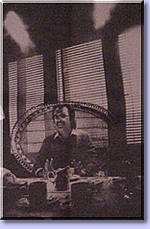
PAUSE. MORODER checks his watch, realises
he is half an hour late for a mixing session, lets Jill snap him downstairs
in the studio before courteously absenting himself elsewhere.
But let me tell you something. Meeting Moroder and finding him as straightforward
and pragmatic about his work encouraged me. Enormously.
I had baulked at the prospect of the interview - for fear of having him
confirm that the 'disko' mind-priests were right after all, that, yes,
"I Feel Love" was intended as a piercingly incisive commentary
on Man and Machine and Modernity, that all we have left to ourselves are,
as the stiflingly pretentious and presumptious Ultravox (themselves often
cast as another relay station in the New Europe network) would have it,
system of romance. Or dance.
There are times - now, for instance - when i worry that the bulk of music
press 'criticism' is, comme on dit, not only out to lunch but out to every
meal in the week. Much too much of it refuses to accept the canons of
popular taste. Which wouldn`t be so bad in itself (empiricism is good
for you) is only this rejection of populism wasn`t so rife with virulent
narcissism and elitism.
Which is why, in turn, I resent the meaningless Euro-schtick that has
been slapped on Moroder and, crossing the floor, I resent writers playing
self-exclusive mind-games with fashion and fancy...
There will, I suppose, always be those who feel the need to rationalise.
We Westerners think too much. But how, as our own Danny Baker has pointed
out, can anyone reasonably expect to review disco sitting down?
Of course there's as much, maybe more, bad, carelessly and shoddily conceived
disco as there is good. But so what? The same could be said of rock, funk,
soul, jazz even, whatever.
Amanda Lear, for instance, with all her inane gobbledygook about 'intellectualising'
disco, is as (s)exploitative as, let's see now, any pseudo-punk poseur
(and we must repeat: Amanda Lear is big in Italy and Germany).
But so it goes and will go as long as this thing called money makes our
world rotate. And you still want the world and you want it now? Don`t
make me laugh.
Moroder's approach to disco has something in common with Parliafunkadlicments
consciously radical debunking of funk. It doesn't take itself too seriously.
It is, I believe, fundamentally positive, subversive even.
Naturally Moroder is doing very nicely for himself but, as intimated earlier,
his sense of responsibility for his work and his insistence on maintaining
standards puts many supposedly 'aware' and 'concerned' rock artists to
shame.
AND
DISCO as soul and R&B? Pace the purists, but homogenisation is and
will remain an occupational hazard or, depending on your point of view,
an occupational advantage of any music industry geared to mass consumption.
I admire who are prepared to try and raise standards in the public arena.
The two extremes can and must continue to co-exist.
Moroder's own public contribution deserves a far fairer, and far less
fanciful, hearing than it has hitherto received in critical circles. Or
maybe it doesn't matter. Like, say, Northern Soul, so much disco is direct-inject:
from factory floor (ho, ho) to dance floor, bypassing the critical grill
and grid.
Disco? Giorgio Moroder? It's too late to be hateful. It's not too late
to be grateful. Over and out.
Article from NME (New Musical Express) December 1978
|